On June 22, 2026, Hein Matthee published a post on the OpenNebula blog with a blunt claim: moving to VMware Cloud Foundation 9.1 is not a version upgrade, it is rebuilding your infrastructure from the ground up. And that clashes with VMware’s original promise of simpler management.
The warning is aimed at teams still running vSphere 8, which loses support on October 11, 2027. That deadline forces a decision, and the article argues that the path of least resistance (jumping to VCF 9.1) carries more weight than it looks.
What changes in VCF 9.1
The first issue is the management layer. VCF 9.1 is not run from a single console. It relies on several dedicated appliances: SDDC Manager, NSX Manager, VCF Operations, VCF Automation, Fleet Manager, and Collector services. Each one is deployed, maintained, monitored, upgraded, and secured separately. Production setups usually keep a management domain apart from the workload domains, which eats into the capacity available for the applications that actually run the business.
Then there is storage. vSAN becomes the default integrated platform in the validated reference architectures. VMware has announced the deprecation of vVols, with support set to be removed in a future release. Anyone with money already in SAN, NAS, iSCSI, or Fibre Channel has to rethink their long-term plan.
The third point is networking. NSX is baked in as a core component, embedded in both management and workload domains. That means new workflows and extra training for teams coming from a more traditional networking model. On top of that, CPU series flagged as deprecated can push hardware refreshes onto a timeline you would not have picked.
What OpenNebula proposes
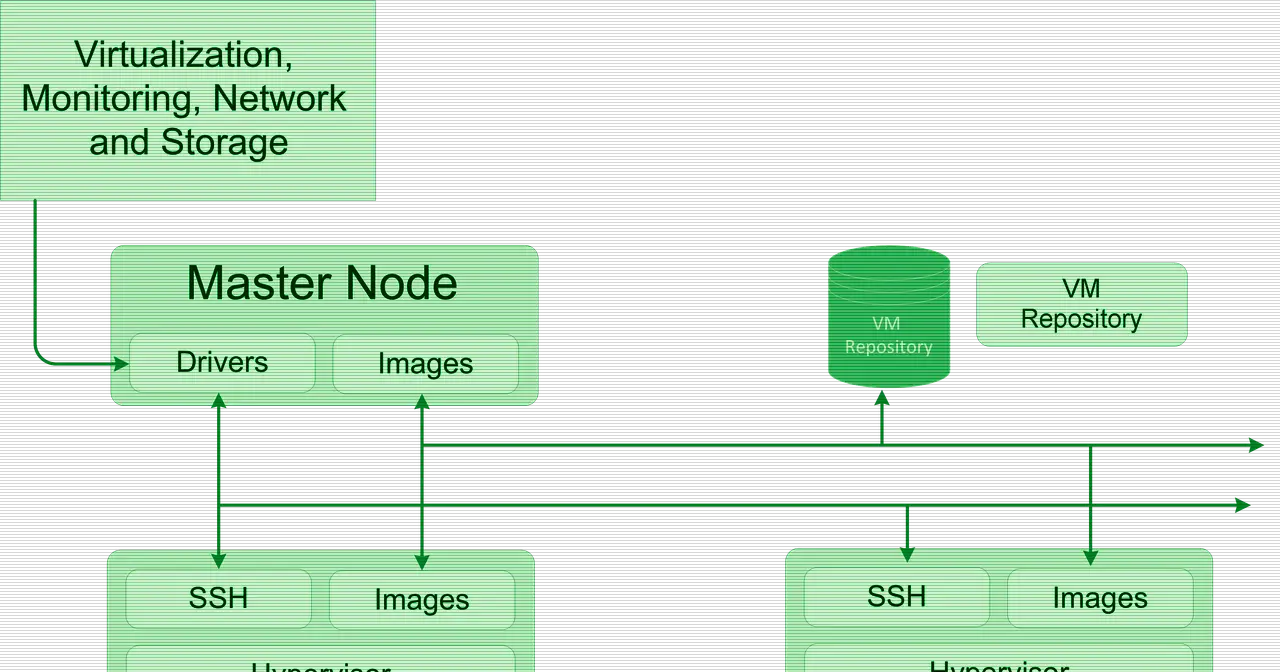
Against that model, the article positions OpenNebula on KVM as a simpler thing to operate. A minimal OpenNebula Frontend needs only 16 GB of RAM, far from VCF’s stack of dedicated appliances, which leaves more physical capacity for the applications themselves.
On storage it does not force vSAN: it works with iSCSI, Fibre Channel SANs, NFS, Ceph, local disk, and enterprise arrays, fitting around what you already own. On the network you can stay with plain VLANs or reach for VXLAN overlays and Open vSwitch when you need them, with no mandatory NSX. It also supports a wide range of x86 platforms and Linux distributions, which helps you get more out of existing hardware.
For all that lightness, it keeps the features expected from an enterprise platform: multi-tenancy, self-service provisioning, role-based access control, monitoring and reporting, automation and orchestration, Kubernetes integration, and hybrid and edge cloud support.
Who should care
Teams that run VMware and are doing the math for life after vSphere 8. If the question is whether the complexity, infrastructure requirements, and subscription cost of VCF 9.1 are worth it, the post invites infrastructure teams to look at KVM before assuming the VMware road is the only one. To see how the pieces of that stack fit, we have a walkthrough of KVM, QEMU and libvirt and the KVM profile with its support details.
Source
Original article by Hein Matthee on the OpenNebula blog: https://opennebula.io/blog/experiences/vmware-vcf-9-1/. At LinuxGratis we follow OpenNebula as an aggregator of news around KVM and Linux virtualization.