Some operating systems became famous for their interface, others for being free, others for running everywhere. VMS earned its reputation through something much harder to show off: it never crashed. For nearly five decades it has run banks, stock exchanges, power plants and railway networks with a reliability that system administrators still talk about with respect. This is its story.
Origins: the Star and Starlet projects
In April 1975, Digital Equipment Corporation (DEC) started a project to build a 32-bit extension of its successful PDP-11 line. The hardware was code-named Star and the operating system Starlet. That work produced the VAX-11/780 minicomputer and its operating system, announced together on October 25, 1977, as VAX/VMS (Virtual Address eXtension / Virtual Memory System). Version 1.0 was announced that same day and began shipping in late 1978.
Roger Gourd led the project, but the technical work fell to three engineers who became legends: Dick Hustvedt, Peter Lipman and, above all, Dave Cutler. The Starlet code name still survives in system libraries such as STARLET.OLB.
From VAX/VMS to OpenVMS
VMS grew alongside the VAX hardware throughout the 1980s. With version 5.0 in April 1988, DEC began calling the system simply VMS. The big identity change came in July 1992, when DEC renamed it OpenVMS to underline its commitment to open standards such as POSIX and Unix compatibility.
That same period brought its first big architecture jump. In 1989 DEC began porting the system to its new 64-bit Alpha AXP processors, and OpenVMS AXP arrived in 1992 with a confusing version number: 1.0. They had restarted the count for the new platform.
Key versions and architecture jumps
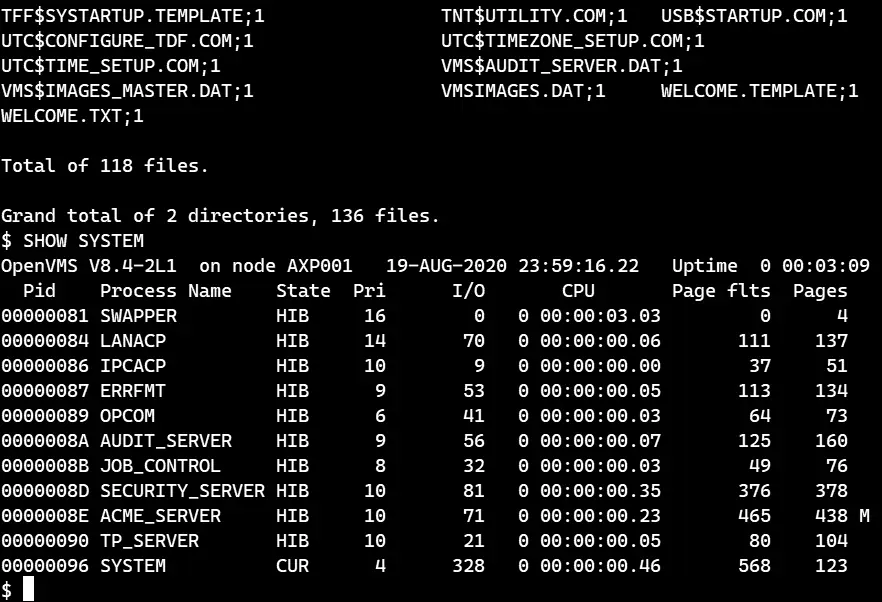
The history of OpenVMS is also the history of its hardware moves, something rare for such a veteran system:
- VAX: the original platform, from 1977 to the last VAX machines.
- Alpha (AXP): ported from 1989, with OpenVMS AXP 1.0 in 1992.
- Itanium (I64): after DEC was bought by Compaq and then HP, the system moved to Intel Itanium processors. Pre-production releases 8.0 and 8.1 appeared in 2003, and the first production version, 8.2, in February 2005, with the same features on Alpha and Itanium.
- x86-64: the most recent leap. OpenVMS V9.2, released in 2022, is the first production version for x86 processors, with support for hypervisors such as KVM, VirtualBox and VMware.
VSI: the system’s second life

In 2013 HP announced it would stop developing new versions, and many wrote the system off. Then in 2014 a new company, VMS Software Inc. (VSI), secured the rights to keep developing it. VSI kept OpenVMS alive on Alpha and Itanium and took on the ambitious job of porting it to x86-64, which opened the door to running it on modern hardware and virtual machines. Today OpenVMS still gets updates, a rare case of an almost fifty-year-old system that is still under active development.
Clustering and legendary reliability
If anything defined VMS, it was its clustering capability. The technology, first called VAXcluster and later VMScluster, lets several different machines work as a single server. You can shut down, upgrade or replace each node, even swap out its operating system, then bring it back into the cluster without interrupting service. The result is uptime measured in years.
The anecdotes are famous: there is talk of an Irish railway cluster that kept its application available for 17 straight years, and documented installations with over a decade of uninterrupted uptime. Few systems can claim anything like it.
The curiosity: VMS, WNT and a nod to HAL 9000
VMS’s most talked-about connection is its kinship with Windows. When DEC cancelled the PRISM project and its MICA operating system, Dave Cutler left the company for Microsoft, where he led the creation of Windows NT. Many then noticed an unsettling coincidence: the initials WNT are each letter of VMS shifted one position forward in the alphabet. Microsoft always maintained that NT came from the “N-Ten” prototype based on Intel’s i860 chip, but the legend persists, much like the wink from fans of 2001: A Space Odyssey, who point out that HAL is IBM shifted by one letter.
If you want to see that lineage up close, you can look at the Unix roots of FreeBSD or Solaris, or compare philosophies with QNX, another system obsessed with reliability. VMS proved that an operating system could be, above all, a promise that it would never let you down.