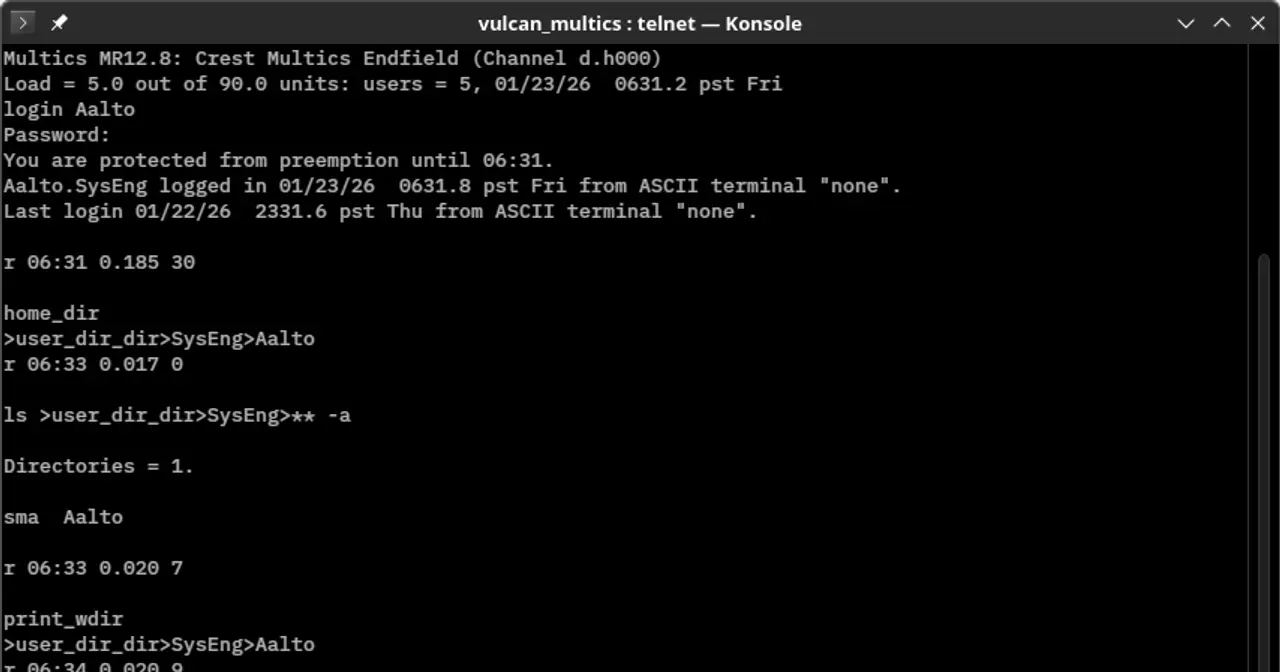
Few operating systems shaped what came after them the way Multics did, and few are so little known outside the trade. Its name rarely turns up in modern manuals, yet without it there would probably be no Unix, no Linux, and none of the systems we rely on today. Multics was, quite literally, the grandfather of an entire computing dynasty.
A project too ambitious for its time
Multics began in 1964 as a three-way collaboration between MIT (through the famous Project MAC, led by Fernando Corbató), General Electric and Bell Labs. The name is an acronym for Multiplexed Information and Computing Service, which sums up the idea well: computing as a public utility, available to many users at once, like electricity or water.
General Electric’s proposal won out in May 1964, much to the surprise and chagrin of IBM, and the contract was signed that August. The plan was a time-sharing system that could serve hundreds of simultaneous users from remote terminals. That sounds ordinary now, but back then most computers still worked through jobs one at a time.
The machines that brought Multics to life
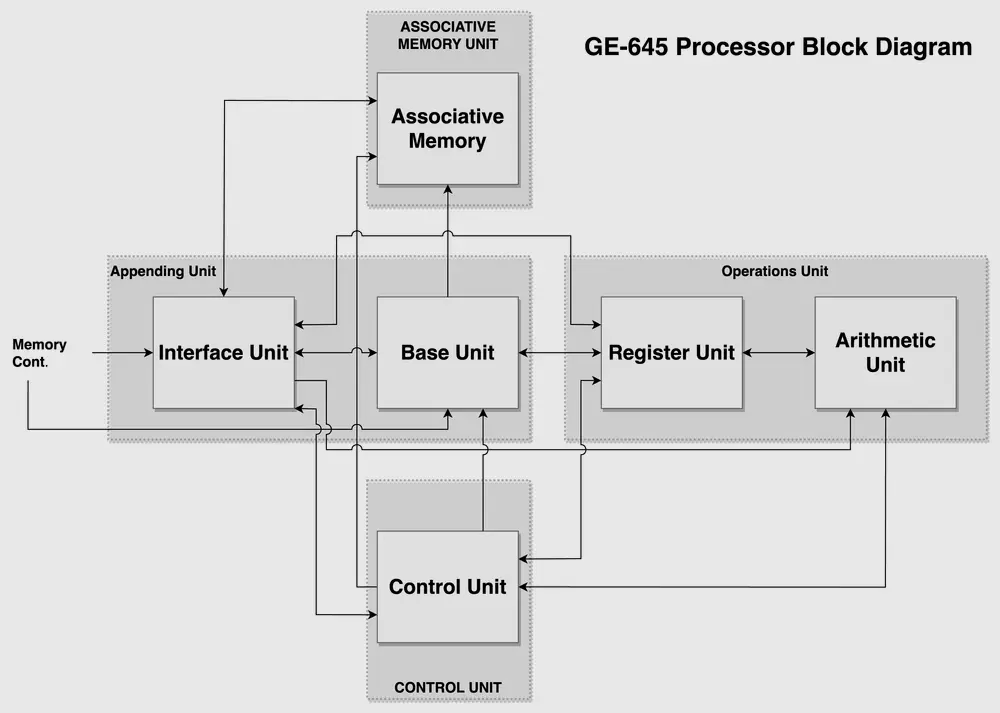
Multics first ran on the GE-645, a special variant of the GE-600 series with support for segmented and paged virtual memory. The first system reached MIT in January 1967, and in October 1969 it opened for general use within the institute.
The catch was that the GE-645 had no hardware support for some of Multics’ most advanced ideas, such as protection rings. They had to be emulated in software, and that ate into performance. Things got much better with the Honeywell 6180, available from 1973, the first machine with the power and the hardware Multics needed, native security rings included. Honeywell had absorbed General Electric’s computer business, and active development of the system continued until 1985.
Ideas decades ahead of their time
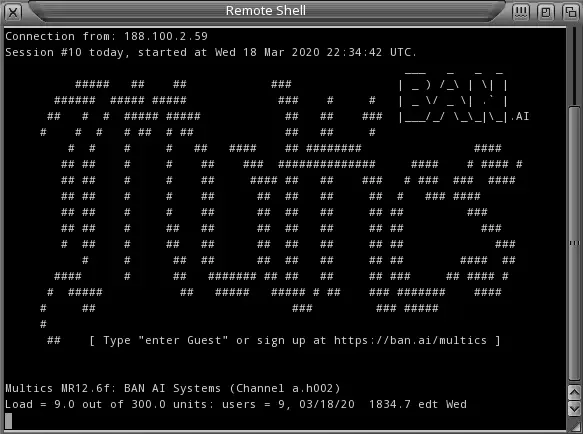
What’s astonishing about Multics is how many things we now take for granted were born or popularized there: a hierarchical file system with tree-structured directories, virtual memory with single-level storage, dynamic linking, security through protection rings, and the ability to reconfigure the system on the fly, without shutting it down.
It was also one of the first operating systems written in a high-level language, PL/I, rather than assembly. That bet on portability and readable code pointed straight at what Unix would later do with C. Anyone working today with systems like Linux, FreeBSD or Solaris is unknowingly using ideas that Multics helped define.
The birth of Unix
This is where the most famous part of the story begins. Bell Labs withdrew from the project in 1969, having seen that Multics would not deliver a working system any time soon: too large, too complex, too expensive. But some of the engineers who had worked on it, among them Ken Thompson and Dennis Ritchie, did not walk away unmoved.
Frustrated but full of ideas, they set out to build a far smaller, simpler system that would fix what they saw as the excesses of Multics. The result was Unix, whose name was in fact a tongue-in-cheek dig at Multics. The influence shows even in the vocabulary: many command names and the very structure of the directory tree drew straight from that experience. From Unix would later descend macOS, the BSD systems and, along a different but parallel path, Linux.
Curiosities few people know
Multics boasts several records. In 1985 it became the first operating system certified at B2 security level under the TCSEC criteria of the National Computer Security Center, a division of the NSA. For its era, one of the most secure systems in the world.
Its longevity stands out too: the last known installation running on Honeywell hardware was shut down on October 30, 2000, at the Canadian Department of National Defence in Halifax. And that wasn’t quite the end: in 2006 the company Bull released the source code of several MR versions (from MR10.2 to MR12.5), which lets enthusiasts study and run it today in emulators. The grandfather of Unix is, in its own way, still very much alive.