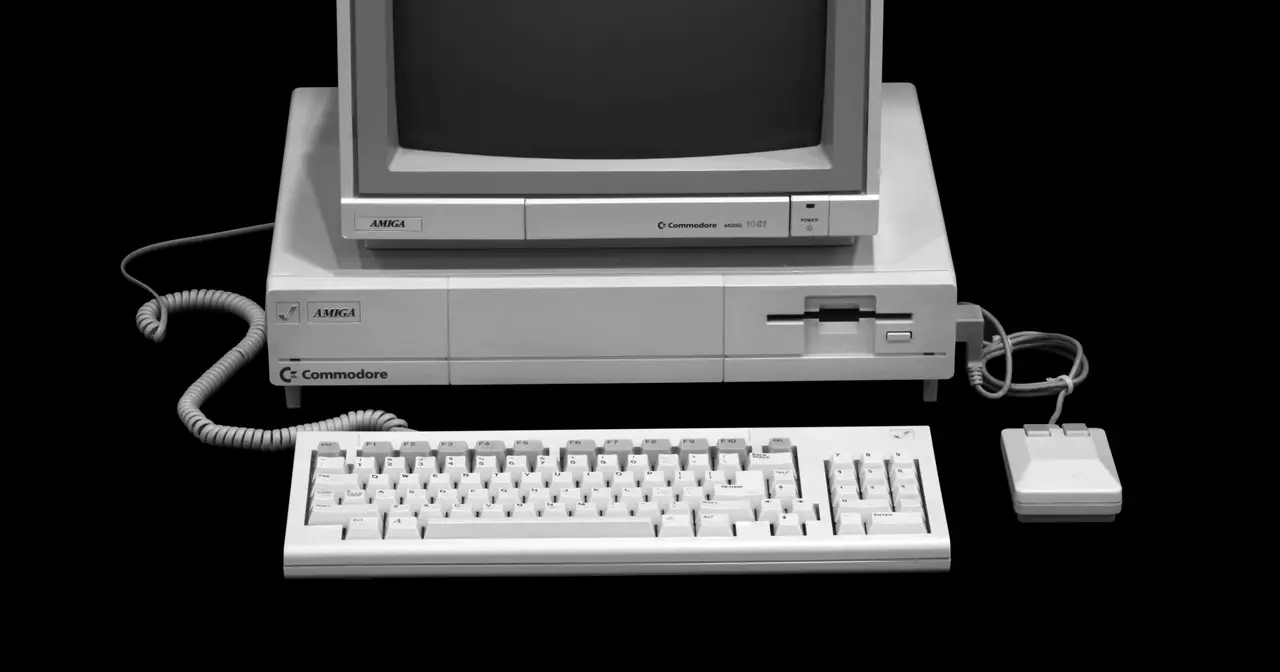
In 1985 most home computers could barely do one thing at a time. Then a machine showed up that played music, pushed spectacular graphics and ran several programs at once without breaking a sweat. That computer was the Commodore Amiga, and its operating system, AmigaOS, left the whole industry stunned. This is the story of one of the most beloved platforms in personal computing.
Origins: from Hi-Toro to Commodore
The project started outside Commodore. A company called Hi-Toro, later renamed Amiga Corporation, gathered a team of engineers led by Jay Miner, a veteran chip designer who came from Atari. They wanted a next-generation video game machine, but the 1983 video game crash forced a complete rethink. Out of funding, Amiga ended up in the hands of Commodore, which bought the company and launched the Amiga 1000 in July 1985, built around the Motorola 68000 processor.
The real genius of the Amiga lay in its hardware. Miner and his team spent almost two years (1982-1984) designing a set of custom chips that took the graphics and sound work off the main processor, something revolutionary at the time.
The chips that changed everything: Agnus, Denise and Paula
At the heart of the Amiga sat three chips with names of their own. Agnus managed access to shared memory and contained the blitter (which moved blocks of data at high speed) and the Copper, a co-processor synchronized with the video beam. Denise handled video and sprites, producing colour palettes that rival machines couldn’t dream of. Paula controlled sound, with four hardware 8-bit PCM audio channels, plus the floppy drive, serial port and joysticks.
With that division of labour, the Amiga delivered benchmark graphics and audio while the CPU stayed free for other tasks. Its multimedia power made it a legendary tool for video production, music and, of course, gaming.
AmigaOS: preemptive multitasking in 1985
The hardware impressed, and the software was every bit as remarkable. AmigaOS offered genuine preemptive multitasking from day one, at a time when the Mac and early Windows could barely run one program at a time. Underneath it ran a lean, efficient kernel called Exec, which truly shared CPU time among processes.
The rest of the system filled out around it: AmigaDOS (the disk layer, first ported from the BCPL-written TRIPOS system and later rewritten in C), Intuition (the windowing API) and Workbench, the graphical desktop with icons, windows and menus that users saw every day. Next to it sat Kickstart, the boot firmware that on the Amiga 1000 had to be loaded from a floppy disk before the system could start.
Key Workbench versions
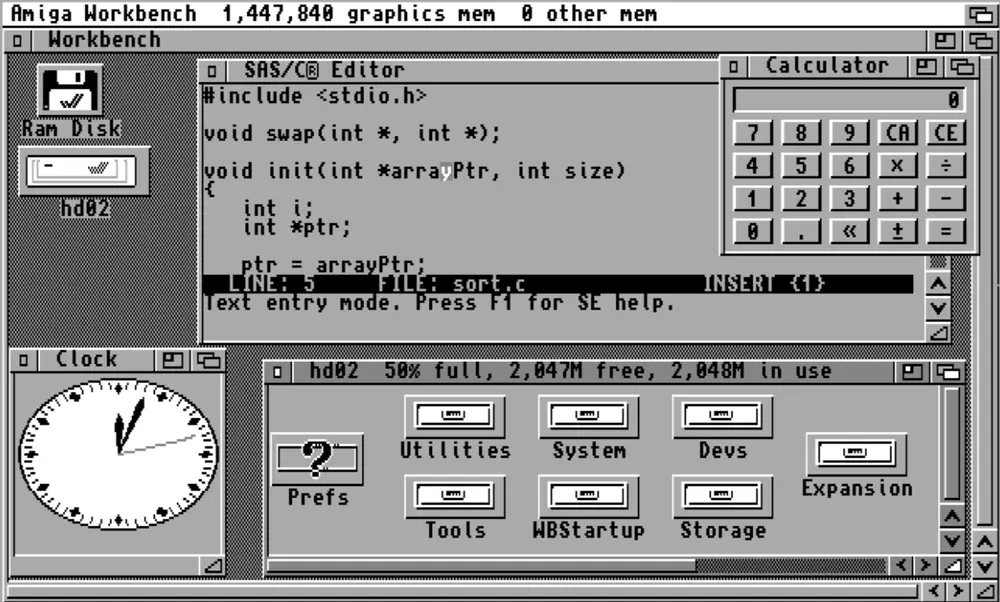
Workbench 1.0 appeared in October 1985 with its distinctive (and divisive) blue-and-orange colour scheme. The big change came with Workbench 2.0 in 1990, which traded those garish colours for a more elegant grey-and-blue interface with three-dimensional raised borders, and set the system’s visual standard.
The AGA (Advanced Graphics Architecture) chipset brought Workbench 3.0 (1992) and 256-colour graphics, soon followed by Workbench 3.1, considered the definitive classic release of the Commodore era and the one shipped with the Amiga CD32 console. After Commodore’s bankruptcy in 1994, development passed through several hands: Escom bought the assets, and years later Hyperion Entertainment brought the system to PowerPC processors with AmigaOS 4, while the community kept parallel projects such as MorphOS and AROS alive.
Curiosities that became legend

The Amiga’s most famous demo was the Boing Ball, a bouncing red-and-white checkered sphere created in a single night during the 1984 CES by Dale Luck and R. J. Mical. The astonishing part is that the animation redrew nothing in real time: it used the custom chips with real cunning to fake the effect, and audiences walked away convinced they were seeing the impossible.
Another signature was the Guru Meditation, the error message that came up when something went seriously wrong, a name so cryptic it became part of computing folklore.
In its day the Amiga competed with systems such as MS-DOS and the classic Mac OS, and today it shares the pantheon of historical systems alongside curiosities like BeOS and Haiku, RISC OS or QNX. To see its technical profile, head to the page dedicated to AmigaOS.