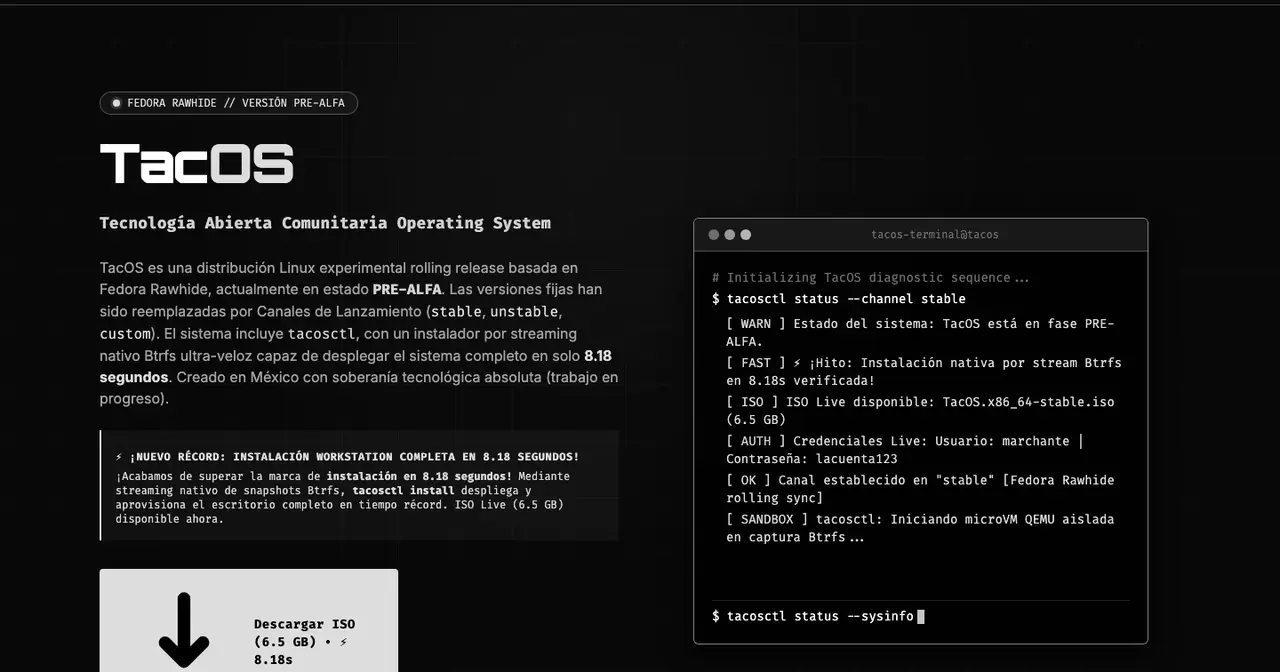
Someone sent us a link to TacOS with a straight question: does it deserve a page on LinuxGratis? The short answer is not yet, but the project is interesting enough to write about. It is a Linux distribution made in Mexico, built on Fedora Rawhide, with a name that is both an acronym (Tecnología Abierta Comunitaria Operating System, roughly “Open Community Technology”) and a statement of intent. The live session user is marchante and the password is lacuenta123. If you have ever ordered tacos at a street stall in Mexico (“¿qué le damos, marchante?”, “la cuenta, por favor”), you get the joke.
Who is behind it
For now, TacOS is a one-person project: Iván Chavero (imcsk8), a free software advocate since 1997, co-founder of the Chihuahua Linux user group and a lecturer at the Autonomous University of Chihuahua. He has worked as an engineer at Red Hat and has a contributor page on the Fedora wiki, so he is no newcomer to the RPM family. The last 50 commits in the repository are his, and the image definition lists him as author.
The code lives on Codeberg, not GitHub, which fits the project’s pitch: “technological sovereignty” and “zero telemetry”, with the honest footnote “work in progress”.
What it proposes
The starting point is a bold one. Fedora Rawhide is Fedora’s development branch, where everything lands before it is frozen for the next release, and it is meant for the people building the distribution, not for daily use. TacOS takes it as a base and tries to tame it with three pieces:
- Channels instead of versions. There is no TacOS 1.0 or 2.0. There are three channels:
stable(validated Rawhide),unstable(the latest) andcustom, meant to let anyone publish their own in the future. The website shows a development number, 0.9.4-DEV, but the repository has not a single tag. tacosctl, a Rust tool licensed GPL-3.0-or-later. Before updating the kernel, the core libraries (glibc, glib2, gtk4, systemd) or a single package, it boots a QEMU microVM on a Btrfs snapshot of the system, tests the change there and watches system calls withstrace. If all goes well, it applies it to the real machine. It also manages snapshots (create, list, roll back), Toolbox-style containers and live kernel swaps withkexec, skipping the BIOS or UEFI.- Btrfs everywhere, with read-only snapshots and incremental replication over ssh using
btrfs send.
The image is built with KIWI-NG, openSUSE’s image builder that Fedora also uses, and the repository has profiles for a live ISO, an OEM disk image and a 2 GB headless QCOW2 microVM. The desktop is GNOME with a dark theme inspired by Tokyo Night and an almost transparent Ptyxis terminal. The server profile brings Cockpit, tmux and Neovim. There is even a mock configuration that tags its own packages with .tcrs (TacOS Rolling Release).
The 8.18 seconds
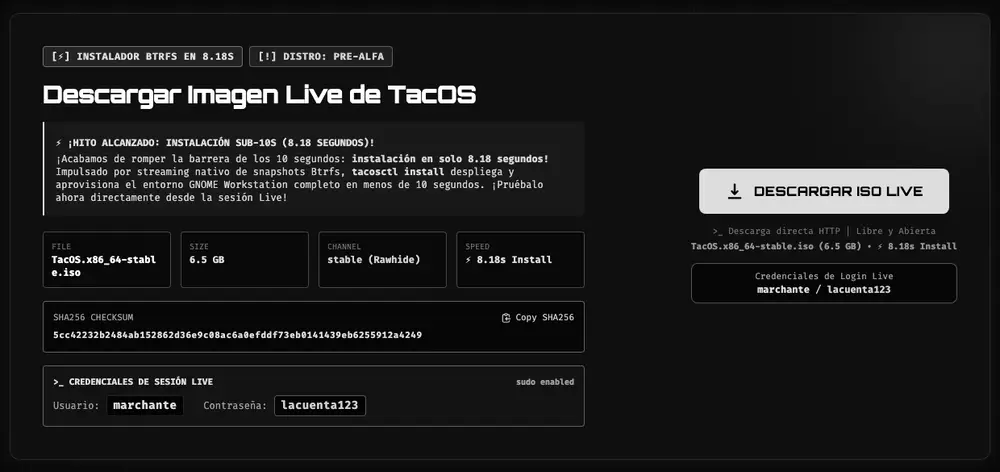
The number that takes up half the homepage is the install time: 8.18 seconds for a full GNOME desktop. There is a trick, and it is not a bad one. tacosctl install does not install packages one by one like Anaconda. It writes a prebuilt Btrfs snapshot to disk, much like the image-based installers of immutable distributions. Copying a whole file system is far faster than resolving dependencies and running every RPM’s scripts.
We have not timed it ourselves, and the result will depend a lot on the disk. What we did check is that the ISO exists: TacOS.x86_64-stable.iso weighs 6,940,418,048 bytes (about 6.5 GB), was uploaded on 20 September and is x86_64 only. That is big for a live ISO: Fedora Workstation’s is less than half that size.
What is still half-built
The website flags almost half of the features in amber. Listed as in progress: optional root immutability for desktop and IoT devices, containerised apps, battery tuning for laptops, Windows compatibility and kexec itself. Two items say a lot about the project:
- Apps for Mexican government services: a CURP downloader, SAT (tax agency) tools based on
libsatand Llave MX login integration. It is the most original part and the one that would be genuinely useful to someone in Mexico. - An AI agent reachable through Telegram for remote administration, with local or paid models. Worth a very close look before enabling it on any machine you care about.
There is also a minor inconsistency that will probably get fixed: the website says everything is GPL-3.0-or-later, but the README clarifies that the build scripts are MIT-licensed and only tacosctl is GPL.
Why it does not have a page yet
On LinuxGratis every system page tracks versions and end-of-support dates, and that is exactly what TacOS cannot give us yet. The repository was created on 4 July 2026 and has 99 commits, zero stars, zero forks and no releases. It sits on a development branch and is maintained by one person. Many projects like this do not make it to their first birthday, not for lack of quality but because maintaining a distribution is a huge amount of work.
That does not mean you should ignore it. If you are into Fedora, Btrfs or immutable distributions, TacOS is a good place to see new ideas: testing every update in a microVM before applying it is something no major distribution does out of the box. Try it in a virtual machine, not on your work computer, and if you find bugs, report them on its issue tracker. If you want to understand why Btrfs makes these tricks possible, see our ext4, Btrfs and ZFS comparison, and Rawhide’s role within Fedora is covered in the history of Fedora.
We will look again once it ships its first tagged release.
Sources: TacOS official website, checked on 23 September 2026; TacOS repository on Codeberg (README, config.xml and the Codeberg API); Iván Chavero on the Fedora wiki; Iván Chavero’s SCALE 20x speaker page.