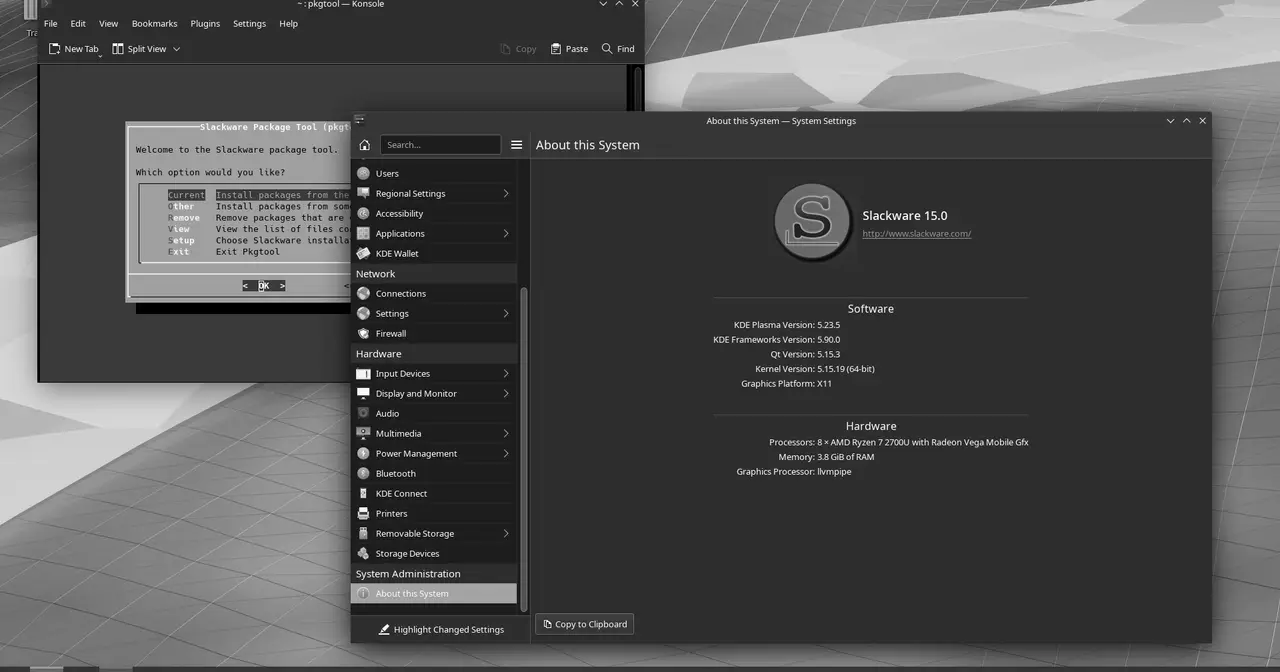
Slackware 15.0 is the latest stable release of the oldest GNU/Linux distribution still in active development. Patrick Volkerding published it officially on February 2, 2022, and it closed one of the longest development cycles in the project’s history: nearly six years had passed since Slackware 14.2. It is a major leap that brings the system’s foundations up to date, yet it stays true to the philosophy that has defined Slackware since 1993: simplicity, stability and a system kept as close to UNIX as possible.
Highlights
- Linux kernel 5.15 LTS: Slackware 15.0 is built on the long-term support 5.15 branch, specifically 5.15.19, so you get compatibility with modern hardware and a long maintenance window.
- KDE Plasma 5: the aging KDE4 is finally retired and replaced by the much more current Qt5-based Plasma 5 desktop. Xfce sticks around as a lightweight alternative.
- PAM integration: Slackware adds Pluggable Authentication Modules to the base system for the first time, falling in line with the rest of Linux on authentication.
- Wayland support: Wayland joins the core system and lays the groundwork for the future of the graphical stack beyond X11.
- UTF-8 by default and Python 3 migration: the default encoding moves from ASCII to UTF-8 system-wide, the migration to Python 3 wraps up, and ConsoleKit2 gives way to elogind.
- Refreshed multimedia stack: components such as FFmpeg, SDL2, the Vulkan SDK and LAME move into the core system, which noticeably improves multimedia and graphics capabilities.
What is Slackware and who is it for?

Slackware is the oldest Linux distribution still maintained, created by Patrick Volkerding in 1993. Its character comes down to hiding nothing from you: it avoids automatic configuration tools, won’t resolve dependencies for you, and prefers plain-text configuration files. That makes it a great fit for anyone who wants to truly understand how a GNU/Linux system works, for administrators who value predictability, and for servers where stability matters more than constant novelty. It is not the easiest distro to start with, but it teaches you more than most.
You can find all the details, support dates and downloads on its full page at LinuxGratis.