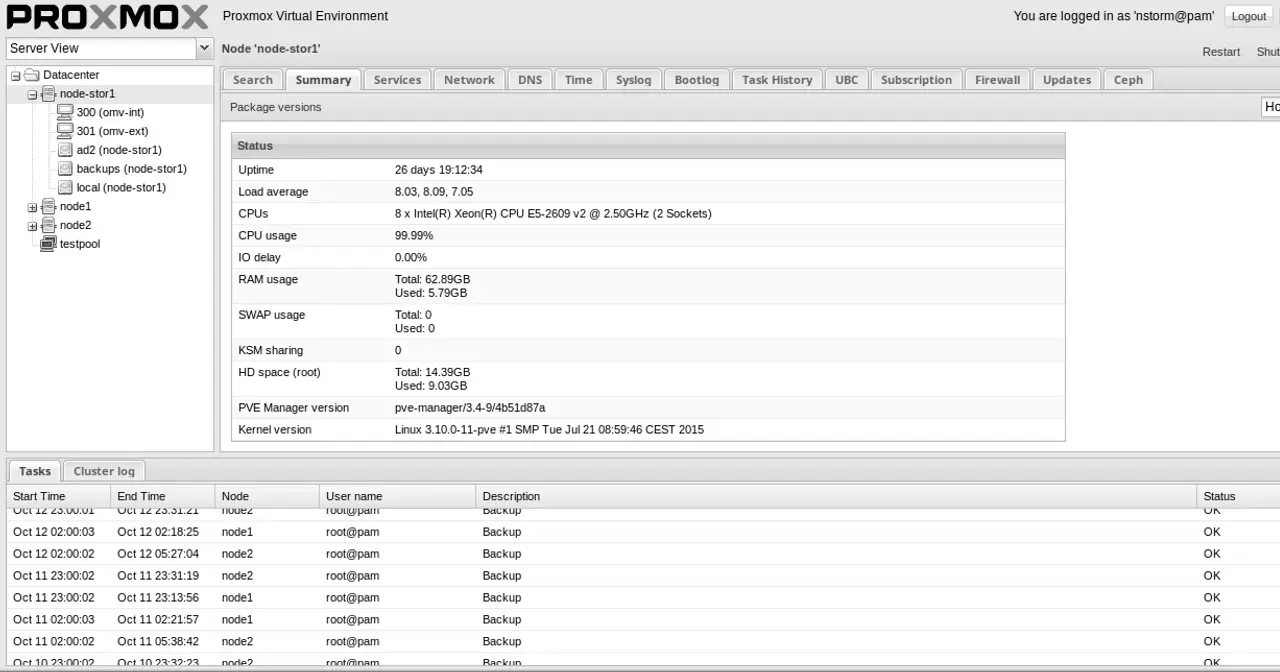
On 21 May 2026 Proxmox released Proxmox VE 9.2. It is a minor release by numbering and considerably more by content: dynamic load balancing lands, the piece people asked Proxmox for every time they compared it with vSphere.
Dynamic load balancing
The Cluster Resource Scheduler (CRS) can now move load between nodes according to how it is distributed, without anyone asking. Until now the CRS decided where to start a machine; from 9.2 on it can also rebalance a cluster that has drifted out of shape.
It is the conceptual equivalent of vSphere’s DRS, and the argument missing from many migration conversations: people coming from VMware took it for granted that the cluster reorders itself.
Disarming high availability for maintenance
Another long-standing request: the HA manager can be disarmed and rearmed cluster-wide. Suspending the HA stack during planned maintenance, so a rebooting node does not trigger a chain of machine restarts, and arming it again when done.
Anyone who has done maintenance on a cluster with HA active knows exactly why this matters.
Custom CPU models, from the interface
Custom CPU models stop being a configuration file and get their own management in the web interface: create, edit and delete profiles without leaving the browser. It is what you touch when mixing processor generations in the same cluster and wanting live migration to keep working.
What is underneath
A Debian 13.5 “Trixie” base with kernel 7.0 as the stable default, QEMU 11.0, LXC 7.0 and ZFS 2.4. In distributed storage, Ceph Tentacle 20.2.1 becomes the stable default, with Ceph Squid 19.2.3 still available as an option. The SDN layer adds IPv6 underlay for EVPN.
Who should care
Anyone with a cluster of more than three nodes, which is where rebalancing stops being a curiosity. And anyone weighing up leaving VMware: two of this release’s three headline features — balancing and disarming HA — answer precisely what was missing in the comparison.
Versions and end-of-support dates are on the Proxmox VE entry. If the plan is to migrate, the VMware to Proxmox guide has the phases and the details that bite; and to do it with company, Migración Proxmox also has a savings calculator and Cloud Privado a platform comparison.
Source: Proxmox VE 9.2 press release.