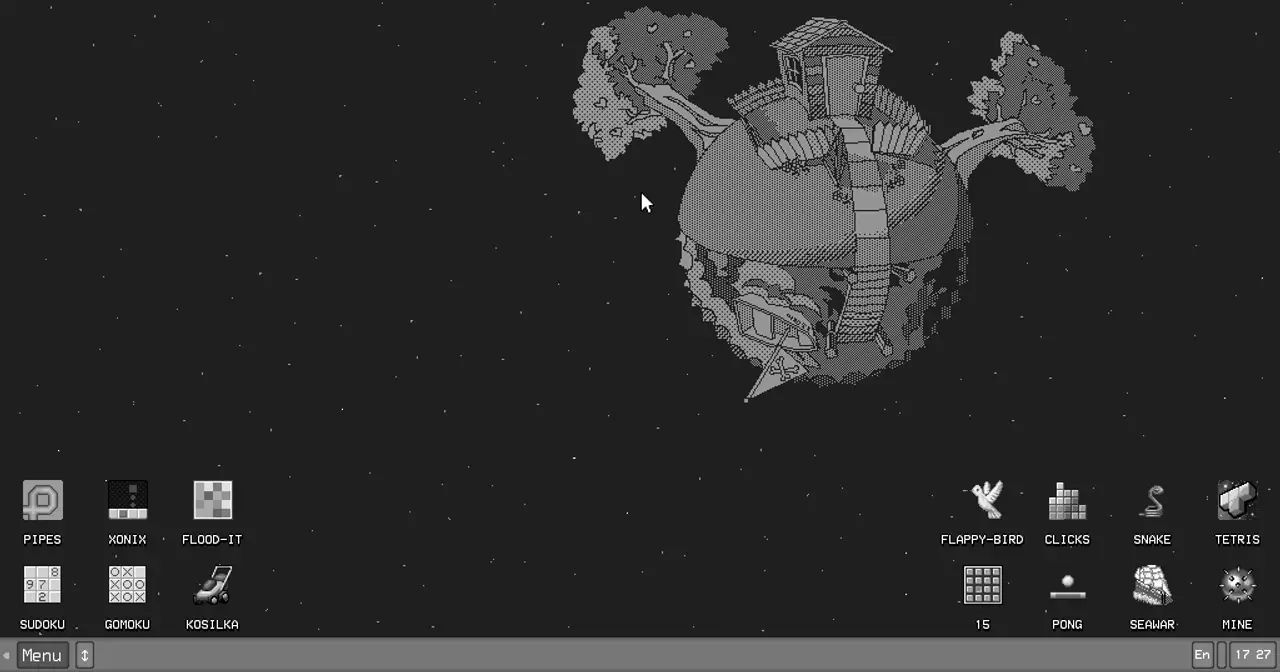
Picture a complete operating system, with a graphical interface, multitasking, a web browser and even a working port of DOOM, that fits entirely on a 1.44 MB floppy disk and boots in a few seconds. This isn’t retro science fiction. It’s KolibriOS, one of the most jaw-dropping feats of engineering in the free software world. It’s written entirely in assembly language, and it shows how far programming can go when every single byte counts.
A Hummingbird Born From MenuetOS
The KolibriOS story begins in 2004, when it was forked from MenuetOS, an equally tiny operating system also written in assembly. The first version came from Marat Zakiyanov, known in the community as “mario79”, and started out as little more than a driver fix for the Russian-language MenuetOS distribution.
The two projects soon parted ways. Shortly afterwards the MenuetOS developer decided to focus only on the 64-bit edition, which on top of that went closed source. KolibriOS stuck with 32-bit and, more importantly, kept its open and free nature. That let it grow thanks to an international community.
The name is no accident either. Kolibri means “hummingbird” in several Slavic languages, which captures the system’s two great virtues perfectly: its tiny size and its astonishing speed.
Coding to the Limit: All in Assembly
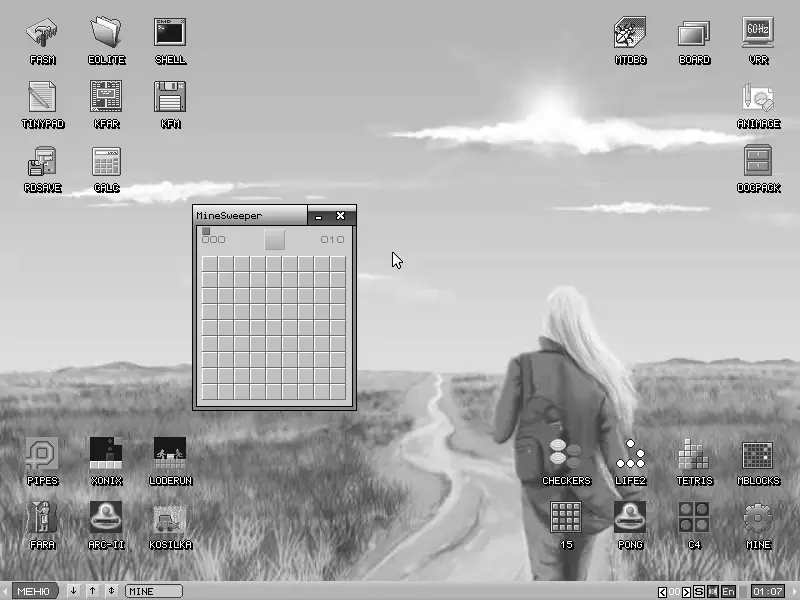
What makes KolibriOS truly unique is its radical philosophy. Most modern systems are written in C or C++ and weigh in at gigabytes; KolibriOS is programmed from top to bottom in FASM (Flat Assembler). That absolute control over the hardware is what lets the kernel and a handful of essential applications fit inside a 1.44 MB floppy disk image.
Despite its toy-like footprint, the system offers a full graphical interface, preemptive multitasking, a working TCP/IP network stack and support for Ethernet cards. It recognises a long list of file systems: FAT12, FAT16, FAT32, ext2, ext3, ext4 (partial), NTFS, exFAT (read-only), XFS and CDFS. To put the achievement in perspective, an entire operating system takes up less space than a single photo from today’s smartphones.
Versions and Development Branches
KolibriOS has been in continuous development since 2004, thanks to contributors from Russia, Kazakhstan, Ukraine, Belarus, Uzbekistan, Moldova, Estonia, Germany and Belgium. It runs on i586 processors or newer, which makes it perfect for breathing life back into old machines that any modern Linux distribution would write off as scrap.
Over the years the project has branched into several specialised editions:
- KolibriOS (main branch): the general-purpose version, with a graphical interface and all the bundled software.
- KolibriACPI: a variant with extended ACPI support for better power and hardware management.
- Kolibri-A: an exokernel edition tuned for embedded applications and hardware engineering.
You can boot it from a 3.5“ floppy drive, a hard disk, a USB flash drive or a CD-ROM, which gives it plenty of room for tinkering and experimentation.
More Than 250 Programs in a Few Megabytes
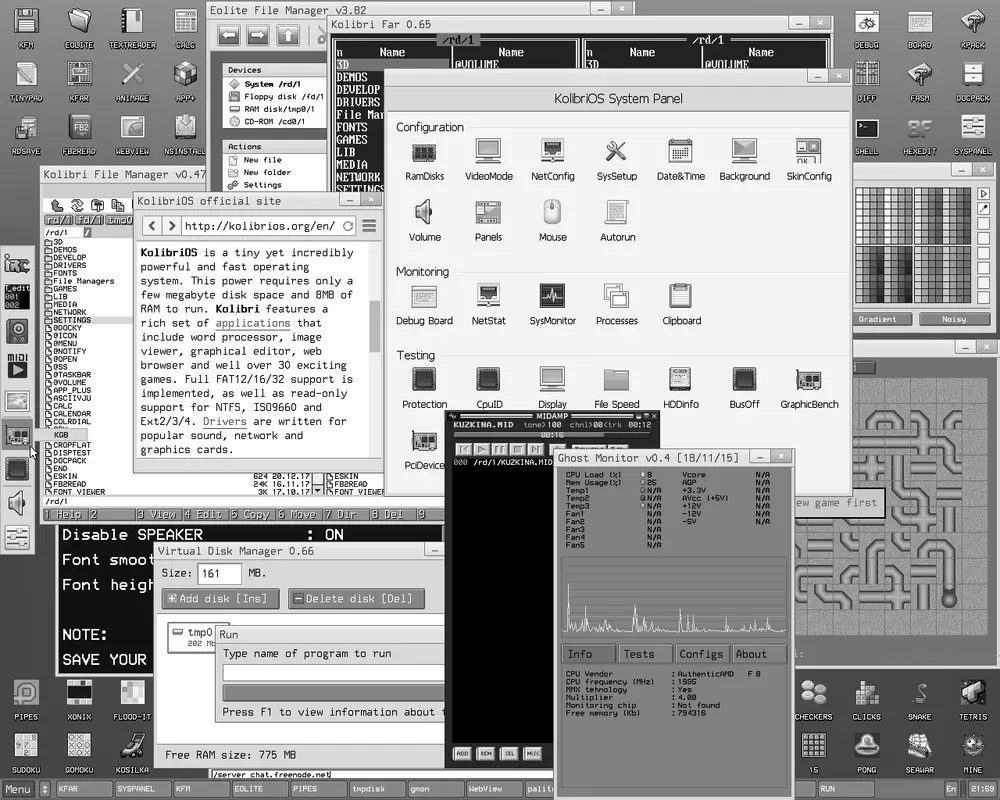
Tiny doesn’t mean limited. KolibriOS ships with over 250 bundled software packages: a word processor, an image viewer, a music player, a web browser and even a code editor with its own built-in macro assembler (FASM), so you can program the system from inside the system itself.
And because it’s not all work, it comes with games too. There are ports of classics like DOOM and Wolfenstein 3D, running via software rendering, alongside Tetris, the timeless Snake and Minesweeper variants. The fact that a floppy disk can run DOOM still feels like magic.
A Record-Breaking Curiosity: Encoded in DNA
If there’s one anecdote that captures the almost legendary status of KolibriOS, it’s this one: researchers at Columbia University and the New York Genome Center actually encoded KolibriOS into synthetic DNA, alongside other data totalling 2,342 KB. Thanks to its extraordinarily small size, this operating system became one of the few ever stored inside a biological molecule. Not many systems can claim to have gone from the floppy disk to the strands of life itself.
A Tribute to the Art of Small Software
When even a simple messaging app eats up hundreds of megabytes, KolibriOS is a refreshing reminder of what discipline and a deep understanding of the hardware can achieve. It shares conceptual kinship with other niche, open-source systems such as ReactOS, the educational MINIX and the legendary TempleOS. If you genuinely want to understand how a computer works under the hood, few projects are this instructive and this much fun at once.