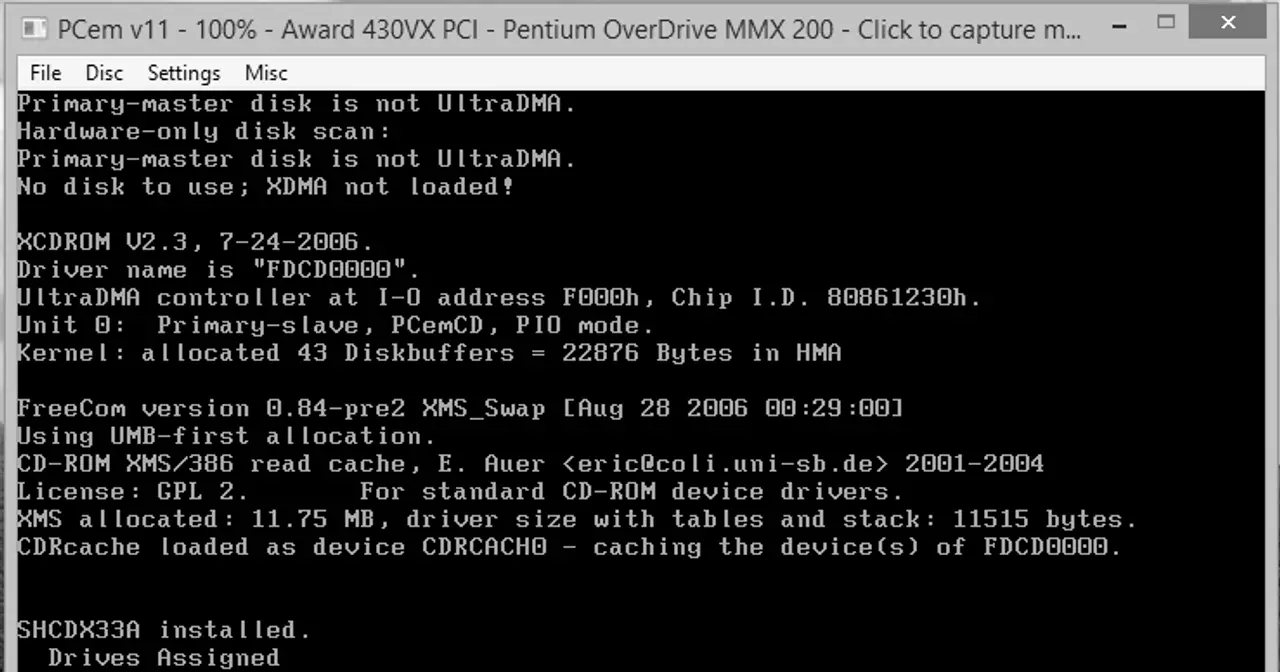
When Microsoft announced in 1994 that it would stop selling and supporting MS-DOS, most people assumed the old command-line interpreter would vanish for good. A physics student had other plans. Three decades later, FreeDOS is still alive, under active development, and downloaded around the world. This is the story of how free software rescued an operating system the industry had already buried.
The Announcement That Changed Everything
In early 1994, Microsoft was clearing the way for Windows 95 and confirmed that the last standalone release of MS-DOS, version 6.22, would also be its final one. For the millions who relied on the system to work, play, or run custom software, it was unwelcome news.
On 31 March 1994, a message on the comp.os.msdos.misc newsgroup asked whether anyone, perhaps the GNU project, had ever considered writing a public-domain DOS. The question reached Jim Hall, then a physics student at the University of Wisconsin-River Falls. On 29 June 1994 he posted a manifesto proposing a free DOS, which he named PD-DOS (for Public Domain DOS).
From PD-DOS to FreeDOS
Hall chose “PD-DOS” because he wanted a system that was free for everyone and assumed that meant “public domain.” He soon grasped the difference between public domain and free software, so within weeks he renamed the project Free-DOS and decided to release the code under the GNU General Public License (GPL). The hyphen was later dropped to give us FreeDOS, partly following the publication of the kernel written by Pat Villani, who joined the effort early on.
Progress was swift. The developers pooled their own utilities and, just months after the announcement, released Alpha 1 in September 1994. An operating system born on Usenet was taking shape as a genuine alternative.
FreeDOS’s Key Releases
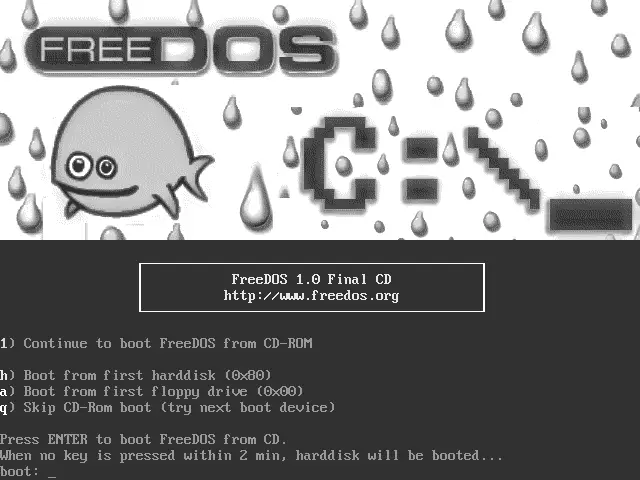
The road to a stable version was long, but each milestone marked a leap in maturity:
- FreeDOS 1.0 (3 September 2006): the first stable release, twelve years after the project began. It shipped on two CDs, an install disc of about 8 MB and a roughly 49 MB live CD that also held the source code.
- FreeDOS 1.1 (2 January 2012): updated packages and better compatibility.
- FreeDOS 1.2 (25 December 2016): a reworked installer and a broad collection of ready-to-run software.
- FreeDOS 1.3 (February 2022): more drivers, games, and networking tools.
- FreeDOS 1.4 (April 2025): the most recent release, an “updates” version that adds the Dosview image viewer (reading BMP, PNG, JPG, WEBP, and GIF), a fixed FDISK for disks with many logical partitions, and a new build of Michael Brutman’s mTCP networking suite.
Real Trivia About a Very Much Alive DOS
It sounds paradoxical, but FreeDOS is one of the most genuinely useful classic operating systems today. Its most common use might surprise you: for years, many manufacturers have recommended booting into FreeDOS to flash the BIOS of motherboards and laptops, because plenty of firmware utilities only run in a real DOS environment. A relic of the nineties serving modern hardware.
FreeDOS has even been sold preinstalled on new computers as a license-free option, an elegant way to offer a “no OS” machine that still boots. And, of course, it remains a haven for the nostalgic: it runs thousands of classic DOS-era games and applications without emulation, and it sits comfortably inside virtual machines like VirtualBox or QEMU running on Linux.
One more endearing detail: Jim Hall is still the project’s coordinator more than thirty years on. Few operating systems can boast such continuity with their original founder still at the helm.
A Legacy That Connects Generations

FreeDOS shares its DNA with a whole family of systems that defined personal computing: Microsoft’s MS-DOS, IBM’s PC DOS, Digital Research’s advanced DR-DOS, and, further back, the legendary CP/M that inspired them all. Against those proprietary systems, FreeDOS offered something different: being free, open, and maintained by a community.
Today, in the age of the cloud and artificial intelligence, the fact that a 16-bit DOS still receives updates is almost an act of cultural resistance. FreeDOS proves that free software does not only build the future, it can also rescue the past and keep it running for anyone who needs it.