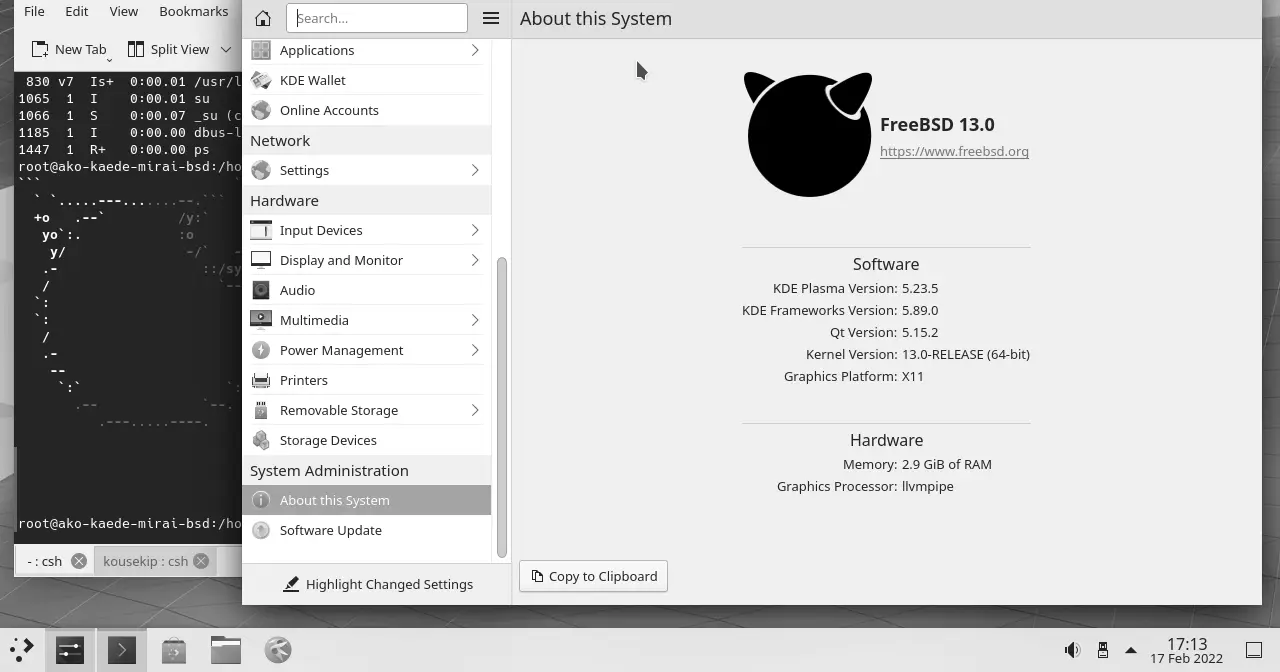
The FreeBSD Project released FreeBSD 15.0-RELEASE on December 2, 2025. It’s the first build from the new stable/15 branch and one of the most significant releases in years. It pairs top-tier security work with a deep rethink of how the base system gets installed and maintained.
Release highlights
- Base system managed with pkg(8): the headline change in FreeBSD 15.0 is that the “base” system can now be installed and managed with the
pkg(8)package manager. This “pkgbase” method ships as a technology preview and will become the standard approach in future releases. - Native inotify: FreeBSD adds a native implementation of the Linux-compatible
inotify(2)interface. That makes directory watching simpler and lets software rely on inotify without any changes. - OpenZFS 2.4: the filesystem moves up to OpenZFS 2.4.0, bringing features such as NFSv4.2 Clone operations using block cloning, and NVMe over Fabrics TCP transport support for both client and server.
- Post-quantum cryptography: OpenSSH moves to the 10.0p2 series with quantum-resistant key agreement on by default, while OpenSSL is upgraded to LTS 3.5.4, adding the standardized ML-KEM, ML-DSA and SLH-DSA algorithms plus QUIC support.
- Kernel changes: support for more than 4 TB of RAM on amd64 with LA57-capable CPUs, and a switch to MIT Kerberos 1.22.1 as the default implementation, replacing Heimdal.
- Containers and cloud: the project now publishes OCI-compatible container images and Oracle Cloud images, and EC2 instances boot up to 76% faster than on 14.0.
One thing to watch: the 32-bit platforms (i386, armv6 and 32-bit powerpc) have been retired, though 32-bit compatibility mode stays on the 64-bit variants.
What is FreeBSD
FreeBSD is a free, Unix-like operating system and a direct descendant of the Berkeley Software Distribution (BSD). It’s known for its stability, network performance and permissive license, which makes it ideal for servers, firewalls, ZFS storage, embedded devices and as a foundation for other products. It suits system administrators and infrastructure professionals, and equally anyone who wants a solid, well-documented Unix.
You can find all the details about this distribution on its page at /en/freebsd.